Brigantine Publishes 2026 Maritime Regulatory Report Brigantine、2026年海事規制レポートを公表

Practical Guidance Covers SOLAS and MARPOL Amendments Through to PSC and RightShip Compliance
SOLAS・MARPOL改正からPSC、RightShip対応まで実務指針を提示
Brigantine Marine Services, an Australia-based provider of ship inspection and PSC compliance support services, has published “Regulatory Radar 2026”, a report summarising the principal international maritime regulatory amendments that entered into force in 2026 and key inspection developments expected in the months ahead.
(The full article is available to read free of charge. The Japanese version follows the English edition)
Brigantine、2026年海事規制レポートを公表
SOLAS・MARPOL改正からPSC、RightShip対応まで実務指針を提示
オーストラリアを拠点に船舶検査やPSC(Port State Control)対応支援を手掛けるBrigantine Marine Servicesは、2026年に発効した主要な国際海事規制改正と、今後注目される検査動向をまとめたレポート「Regulatory Radar 2026」を公表した。
(本記事は全文無料でお読みいただけます。日本語の記事は英語の後に続いています)
Brigantine Publishes 2026 Maritime Regulatory Report
Practical Guidance Covers SOLAS and MARPOL Amendments Through to PSC and RightShip Compliance
Brigantine Marine Services, an Australia-based provider of ship inspection and PSC compliance support services, has published “Regulatory Radar 2026”, a report summarising the principal international maritime regulatory amendments that entered into force in 2026 and key inspection developments expected in the months ahead.
The report outlines amendments to SOLAS, MARPOL and STCW, together with AMSA’s (Australian Maritime Safety Authority) priority enforcement areas and practical responses to PSC (Port State Control), RightShip and SIRE 2.0. As risk-based ship oversight continues to expand internationally, the report serves as a practical reference for Japanese shipowners, ship management companies and shipping operators, at a time when not only vessel maintenance but also Safety Management Systems (SMS), crew training and documentation are coming under increasingly close scrutiny.
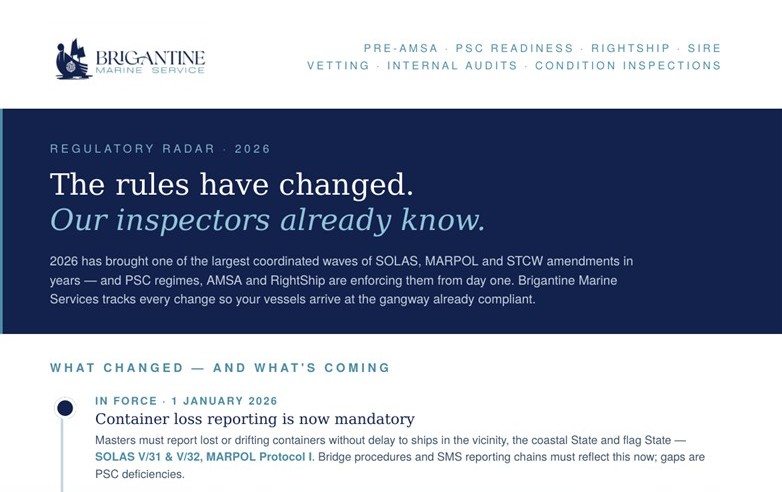
■Major International Maritime Regulatory Amendments Enter Into Force in 2026
The report summarises the mandatory reporting of lost containers introduced in January 2026, restrictions on firefighting media containing PFOS (per- and polyfluoroalkyl substances), mandatory STCW training covering violence, harassment and bullying, amendments to the IMDG Code, and new requirements relating to lifting appliances.
It also provides an overview of significant regulatory developments affecting vessel operations, including the introduction of new Emission Control Areas (ECAs) under MARPOL Annex VI and amendments to AMSA’s Marine Orders. Brigantine says it continuously monitors these regulatory developments and has established a framework to assist vessels in confirming compliance before inspections take place.
■AMSA Further Strengthens Risk-Based Oversight
The Brigantine report also refers to AMSA’s “National Compliance Plan 2025-26”, explaining that the authority intends to conduct more than 2,400 PSC inspections while applying risk analysis based on maintenance standards, SMS implementation and previous deficiency records to determine inspection priorities.
Shipboard maintenance, pollution prevention and cargo securing are identified as principal focus areas, indicating a growing trend towards verifying not only documentation but also the actual management standards maintained on board. The report also introduces services designed to support compliance with these regulatory changes, including Pre-AMSA Inspections, Internal Audits and Condition Inspections.
■Cargo Securing CIC Also Identified as a Key Issue
The report also highlights the Joint Concentrated Inspection Campaign (CIC) on Cargo Securing scheduled to be conducted by the Paris MoU and Tokyo MoU between 1 September and 30 November 2026.
According to Brigantine’s publication, PSC authorities, including AMSA, are expected to participate, with inspection items covering the application of the Cargo Securing Manual, the condition and certification of lashing equipment, compliance with the CSS Code and crew competency. The company also states that it provides Pre-CIC Readiness Checks, including gap analysis before inspections and questionnaire training for shipboard personnel.
■Global Inspection Network and Proactive Support
Brigantine deploys Master Mariners, Chief Engineers and former classification society surveyors across Australia, China, Singapore and Europe, providing Pre-AMSA Inspections, PSC support, pre-assessments for RightShip and SIRE 2.0, and internal audits.
The report also outlines its “Passage Guidance” programme, covering certificate verification before departure, remote support during the voyage, port-specific briefings and final pre-arrival verification. It positions regulatory compliance not simply as preparation for inspections, but as an integral part of day-to-day vessel management.

■ Reporter’s View
Among Japanese shipowners and ship management companies, compliance with PSC and AMSA requirements is often regarded as preparation solely for inspections. In recent years, however, PSC, RightShip, SIRE 2.0 and vetting by cargo owners and charterers have increasingly converged towards a common objective: assessing the overall quality of vessel management.
A deficiency in any one area, whether maintenance, SMS implementation, crew training or certificate management, may affect not only inspection results but also a vessel’s commercial standing. While “Regulatory Radar 2026” serves as a brochure introducing Brigantine’s services, it is also a practical reference that concisely summarises the principal regulatory amendments and supervisory trends for 2026.
Its value extends well beyond vessels trading to Australia. For Japanese shipowners, ship management companies and shipping operators seeking to strengthen their international PSC readiness and RightShip performance, it is a publication well worth reading.
Maritime Bridge Japan Editorial Team
Brigantine、2026年海事規制レポートを公表
SOLAS・MARPOL改正からPSC、RightShip対応まで実務指針を提示
オーストラリアを拠点に船舶検査やPSC(Port State Control)対応支援を手掛けるBrigantine Marine Servicesは、2026年に発効した主要な国際海事規制改正と、今後注目される検査動向をまとめたレポート「Regulatory Radar 2026」を公表した。
同レポートは、SOLAS、MARPOL、STCWの改正に加え、AMSA(Australian Maritime Safety Authority)の重点監督分野、PSC、RightShip、SIRE 2.0への実務対応を整理している。
国際的にリスクベースの船舶監督が拡大する中、船体整備だけでなく、安全管理システム(SMS)、乗組員訓練、証書・書類管理まで厳しく確認される局面に入りつつあり、日本の船主、船舶管理会社、海運オペレーターにとっても実務上の参考資料となる。
■2026年に主要な国際海事規制改正が発効
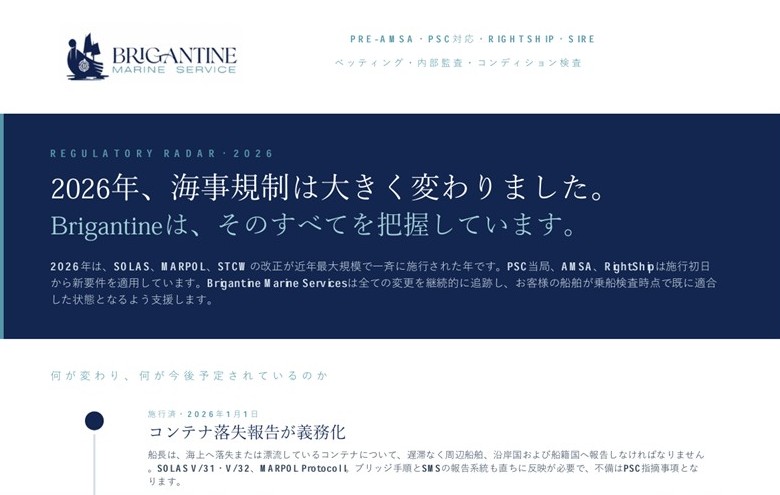
レポートでは、2026年1月に導入されたコンテナ流出時の報告義務、PFOS(有機フッ素化合物の一種)を含む消火剤の使用制限、暴力・ハラスメント・いじめに関するSTCW訓練の義務化、IMDGコードの改正、揚貨装置に関する新要件などを整理している。
MARPOL附属書VIに基づく新たな排出規制海域(ECA)の導入や、AMSAのMarine Orders改正など、船舶運航に影響を与える重要な規制動向についても概説している。
Brigantineは、こうした規制動向を継続的に監視し、検査前に船舶が適合状況を確認できる支援体制を整えているとしている。
■AMSA、リスクベースの監督を一段と強化
Brigantineのレポートは、AMSAの「National Compliance Plan 2025-26」にも言及している。
AMSAは2,400件超のPSC検査を実施する方針で、保守整備水準、SMSの実施状況、過去の指摘記録などに基づくリスク分析を用いて検査対象の優先順位を判断する。
重点分野としては、船上保守、汚染防止、貨物固縛が挙げられており、書類確認だけでなく、船上で実際にどのような管理水準が維持されているかを確認する傾向が強まっている。
レポートでは、こうした規制変更に対応するサービスとして、Pre-AMSA Inspection、内部監査、Condition Inspection(コンディション・インスペクション)なども紹介している。
■貨物固縛CICも重要課題に
レポートは、2026年9月1日から11月30日まで、Paris MoUとTokyo MoUが共同で実施する貨物固縛に関する集中検査キャンペーン(CIC)も重要課題として取り上げている。
Brigantineの資料によると、AMSAを含むPSC当局の参加が見込まれており、検査項目には貨物固縛マニュアルの適用状況、ラッシング機器の状態と証書、CSS Codeへの適合、乗組員の習熟度などが含まれる。
同社は、検査前のギャップ分析や乗組員向けの質問票訓練を含むPre-CIC Readiness Checkも提供している。
■グローバルな検査体制と事前支援を展開
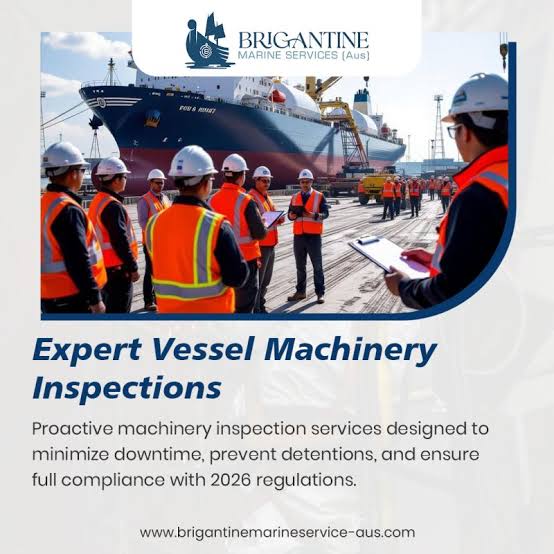
Brigantineは、オーストラリア、中国、シンガポール、欧州にMaster Mariner、Chief Engineer、元船級協会サーベイヤーらを配置し、Pre-AMSA Inspection、PSC対応、RightShip・SIRE 2.0事前評価、内部監査などを展開している。
レポートでは、出港前の証書確認、航海中の遠隔支援、港別ブリーフィング、入港前の最終確認までを含む「Passage Guidance」の概要も紹介している。
規制対応を単なる検査対策ではなく、日常的な運航管理の一部として位置付けている点が特徴だ。
■記者の視点
日本の船主や船舶管理会社では、PSCやAMSAへの対応を「検査のための準備」と捉える傾向が少なくない。
近年は、PSC、RightShip、SIRE 2.0、荷主や用船者によるベッティングが、船舶管理全体の品質を評価する方向に収れんしつつある。
保守整備、SMS運用、乗組員訓練、証書管理のいずれかに不備があれば、検査結果だけでなく、船舶の商業的評価にも影響しかねない。
「Regulatory Radar 2026」はBrigantineのサービス紹介資料という性格を持つ一方、2026年の主要規制改正と監督動向を簡潔に整理した実務資料でもある。
その価値は、豪州寄港船に限られない。
国際的なPSC対応力やRightShip評価の向上を目指す日本の船主、船舶管理会社、海運オペレーターにとって、一読に値する資料といえる。
Maritime Bridge Japan 編集部
- Japanese-Linked Vessels Remaining in the Persian Gulf Fall to 18 ペルシャ湾内の日本関係船、残り18隻に減少
- NYK Names Eighth Dual-Fuel VLGC 日本郵船、8隻目のLPG二元燃料VLGCを命名
関連記事
-
 〆 Inside Report Diverging Views Over New Fuels, MOL’s Hashimoto responds to Maersk「LNG燃料への課金」は是か非か
 -
〆 Inside Report: Why USTR’s New Tariffs Target All Car Carriers Worldwide USTR、全世界の海運会社のPCTC対象の「なぜ」
-
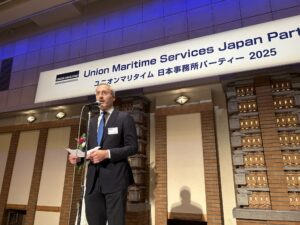
〆 Union Maritime Hosts Second Anniversary Reception in Tokyo:英ユニオンマリタイムが日本事務所設立2周年記念パーティーを開催。
-
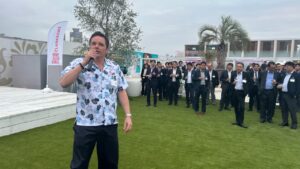
〆 Clarksons Japan Hosts Spring BBQ for Japanese Maritime Stakeholders:クラークソンズ、日本の海事関係者を招きBBQ開催
-
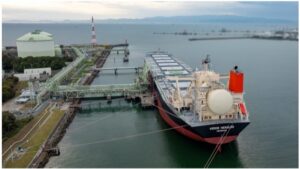
〆Osaka Gas makes first LNG bunkering to MOL’s dedicated iron ore carrier — 大阪ガス、商船三井のLNG燃料鉄鋼原料船に初供給
-
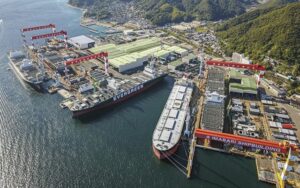
〆INSIDE REPORT: Imabari Shipbuilding sees 2,134 Training Program plans revoked. 技能実習法違反、今治造船だけの問題か。
-
〆 INSIDE REPORT TSUNEISHI Block Loading the Compay’s First Methanol-Fuelled Ship 常石造船、初のメタノール燃料船を建造
-
〆 Inside Report An Exodus from Japan’s Trading Houses’ Shipping Divisions: “止まらない日本の商社船舶部の人材流出

コメント